
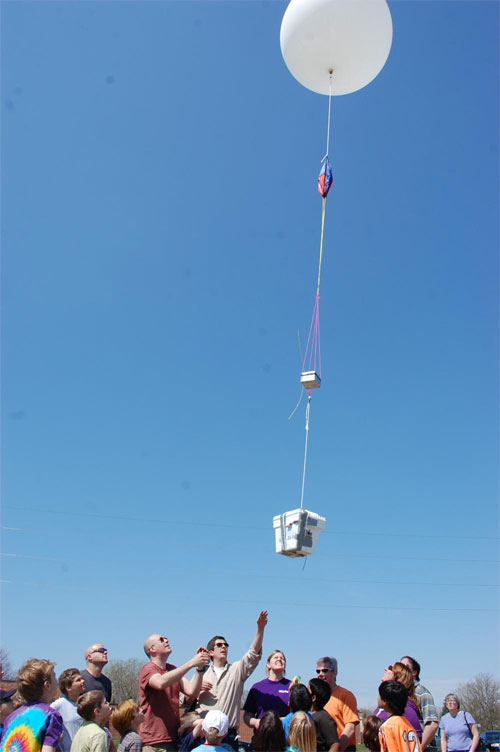
The first thing I dove into when starting this project was the electronics, but the first thing I’ll discuss is the actual payload and recovery systems. Below you can see the standard configuration of a high altitude balloon. The balloon is attached to the apex of the parachute and the payload (or multiple payloads as seen in the picture) is hanging from the parachute risers. The idea is that the balloon will continue to lift the payload until it bursts from the helium expanding at higher altitudes. Then the parachute takes over for the descent.
Balloon
Helium sounding balloons are the standard for these types of projects and there are two places to get them. Military surplus balloons from eBay and sounding balloons from Kaymont. Kaymont supplies pretty much every weather station in the country and each weather station launches two of them every day. So you can rely on these balloons. I’m not an expert on selecting the perfect balloon, but the one chosen by most is the Kaymont KCI 1200. The bursting altitude is 109,000 ft and it’s one of the larger/stronger balloons they offer. Many others have had success with this balloon with a wide range of payloads hanging from it.
Parachute
Kaymont offers parachutes specifically for sounding balloon payloads, but they’re only rated for small loads. Rocketman has a line of parachutes designed for high altitude balloons that can handle a wide range of payload weights. The only difference between these parachutes and the rest on their site is a small loop at the apex of the parachute that allows a balloon to be attached. They have an easy parachute selection chart that shows the different size parachutes, the weight they can handle, and their descent rates. I don’t expect my payload to top 4 pounds, so I chose the 4-foot diameter parachute. This should let it coast down at about 12 mph.
Capsule
The main concern when constructing a capsule is protecting the camera and tracking electronics from extremely cold temperatures. This leads most people to build a capsule out of sheets of thick styrofoam or modifying a small personal cooler (see picture above). It all depends on how much time you want to invest. I am going to adapt a store-bought cooler to house all of my electronics. This is the quickest solution and will keep everything warm and functional. It’s important to note that the FAA has limitations on the weight/size ratio, so a smaller capsule is not always better. You might have to make it larger than necessary to avoid having to follow more strict regulations. I will discuss FAA FAR 101 in a future post.
Camera
Any digital camera can be used for high altitude ballooning. It’s fairly easy to modify a camera to be controlled by your tracking system electronics. Simply wire a few microcontroller pins to the camera’s buttons to “press” them. However, this method requires you to open up your camera, possibly damaging it or making it unsuitable for normal use. The best option is to purchase a Canon digital camera (I chose the SD450) and load the Canon Hack Development Kit (CHDK) on its memory card. There is no way to damage the camera and you don’t have to physically modify it. Tell it to run an intervalometer script and it will take pictures and video at the interval you tell it. This is a very quick and easy method that I will discuss in detail in a future post.
Electronics
The electronics necessary for a near space flight are GPS and some sort of radio transmitter to relay position information to the tracking team on the ground. In addition, you might as well send up some sensors and experiments while you’re at it. I will dedicate several posts to the electronics, how I selected them, and how they work together.


Leave a Reply